
Pediatrician-Reviewed Guide
Parenting Tips: Research-Backed Strategies for Every Age
The best parenting tips all share one foundation: guide your child with encouragement, empathy, and clear boundaries instead of fear or punishment. This guide collects research-backed parenting tips for every stage, from newborns to teens. Pediatrician Janesta Noland, MD, reviewed each one, and all of them are organized around educator Esther Wojcicki’s TRICK Method: Trust, Respect, Independence, Collaboration, and Kindness. Jump to your child’s age below, or start with the five core principles that apply at every stage. The goal isn’t a perfectly behaved child. It’s a close, connected relationship that helps your child grow into a confident, capable adult.
The 5 Core Parenting Tips (TRICK)
If you remember nothing else, lead with these five principles:
- Trust your child until she gives you a reason not to.
- Respect her as a capable person with valid thoughts and feelings.
- Independence: allow age-appropriate autonomy so she learns to decide.
- Collaboration: work with her, not at her.
- Kindness: model the compassion you want her to absorb.

Parenting Tips at a Glance
Here is the one tip that matters most at each stage, with the developmental goal behind it.
| Age | Main developmental goal | Top parenting tip |
|---|---|---|
| Babies (0–12 months) | Trust | Respond to her cries promptly and consistently. |
| Toddlers (1–3) | Autonomy | Offer two simple choices instead of open-ended questions. |
| Preschoolers (3–5) | Managing big emotions | Name her feelings out loud before correcting behavior. |
| School-age kids (6–12) | Competence | Praise specific effort, not talent or outcome. |
| Teens (13–18) | Independence and identity | Listen more than you lecture, and set rules together. |
Parenting Tips by Age
Good parenting tips meet your child where she is developmentally. Psychologist Erik Erikson mapped childhood as a series of developmental stages, each with its own central task, and the tips below follow that arc: trust in the first year, autonomy in the toddler years, and growing competence and independence from there.
- 0–12 monthsTrustRespond every time
- Ages 1–3AutonomyOffer two choices
- Ages 3–5Big emotionsName the feeling
- Ages 6–12CompetencePraise effort
- Ages 13–18IndependenceCoach, don’t direct
Babies (Birth to 12 Months): Build the Foundation of Trust
According to Erikson, your baby’s first year has one central task: learning that the world is a safe place and that her needs will be met. She learns everything through her senses and your responses. Your job right now is simple but powerful: show up consistently.
- Respond to cries promptly. You cannot spoil a newborn. Responsive caregiving builds secure attachment.
- Narrate your actions. Talk out loud as you change, feed, and play. Language development starts now.
- Use warm, calm touch. Skin-to-skin contact and gentle holding regulate a baby’s nervous system.
- Keep routines predictable. Consistent feeding, sleeping, and comfort rhythms teach her that she can count on you.
- Always put her to sleep on her back. Back-sleeping on a firm, flat surface lowers the risk of SIDS.
Source: CDC, Positive Parenting Tips for Infants

More: tips for new parents (ages 0–2) and how to put a baby to bed.
Toddlers (Ages 1–3): Support Her Growing Autonomy
From roughly 18 months to age 3, Erikson’s next stage takes over: autonomy. Your toddler suddenly wants to do it herself, and that drive is healthy. The tools that help most, naming emotions and offering limited choices, start working earlier than many parents expect, even between ages 1 and 2.
- Name emotions out loud. Even a young toddler benefits from hearing “You’re frustrated. That block tower fell down.” It builds emotional vocabulary before she can say the words herself.
- Offer limited choices. “Bananas or blueberries?” gives her a real dose of control at exactly the age she craves it.
- Set soft limits with redirection. Instead of “no,” try “hands are for gentle touching” and demonstrate.
- Let her try. Pulling on socks, carrying her cup, climbing the step. It’s slower, and it’s exactly how autonomy is built.
- Hold off on screens. The American Academy of Pediatrics advises no screen media other than video chatting before 18 months.
Sources: CDC, Toddlers 1–2 and CDC, Toddlers 2–3
Preschoolers (Ages 3–5): Guide Big Emotions
Preschoolers experience huge feelings in tiny bodies. She is not being manipulative; her prefrontal cortex is still years from maturity.
- Keep naming emotions out loud. “You look frustrated. That puzzle is tricky!” deepens the emotional vocabulary she started building as a toddler.
- Expand her choices. “Do you want the red shirt or the blue one?” gives autonomy without chaos.
- Stay consistent with routines. Predictable schedules reduce meltdowns by lowering anxiety.
- Say what to do, not just what not to do. Follow every “no” with the behavior you want instead: “Walk inside, run outside.”
- Praise effort, not outcome. “You kept trying even when it was hard!” builds a growth mindset early.
Source: CDC, Positive Parenting Tips for Preschoolers

School-Age Kids (Ages 6–12): Build Responsibility and Confidence
School-age children crave competence. Specific, positive feedback works better than repeated scolding because it shows exactly which behavior you want to encourage. “I love how you shared your toy with your friend” helps your child connect her action with your approval, making her more likely to repeat it. Research on praise backs this up: children praised for effort tend to persist longer after setbacks than children praised for being smart.
- Assign meaningful chores. Age-appropriate tasks teach contribution and self-reliance.
- Problem-solve together. When conflict arises, ask “what do you think we should do?” before offering solutions.
- Celebrate small wins. Acknowledge progress in friendships, schoolwork, and hobbies regularly.
- Set clear, fair consequences. Natural consequences, not punishments, teach cause and effect.
- Make a family media plan. Agree together on when, where, and how long screens are used, and keep devices out of bedrooms at night.
Source: Mueller & Dweck (1998), Journal of Personality and Social Psychology

More: fun activities for kids by age and online safety tips.
Teens (Ages 13–18): Respect Their Growing Independence
Teenagers are wired to individuate. It’s biology, not rebellion. Positive parenting shifts from directing to coaching.
- Listen more than you lecture. Create space for conversation without jumping to advice.
- Respect privacy while staying connected. Knock before entering. Ask how her day went, and actually listen.
- Negotiate rules collaboratively. Teens respect boundaries they helped create.
- Talk in the car. Side-by-side conversations, while driving or cooking, often feel less intense to teens than face-to-face ones.
- Keep showing unconditional love. Even when she pushes you away, she needs to know you are still there.
Source: CDC, Essentials for Parenting Teens

More: 5 tips for parenting teenagers and parenting tips for teens.
Everyday Parenting Tips for Common Challenges
Most parents don’t search for a philosophy. They search at 7 p.m., in the middle of a meltdown. Here’s how to apply positive parenting to the moments that come up most.
Tantrums and Meltdowns
Stay calm and stay close. A child in the middle of a tantrum can’t take in reasoning, so keep words short (“I’m right here. You’re safe.”), keep her safe, and wait. Talk about what happened once she’s calm, not during the storm.
Sibling Rivalry
Avoid comparing siblings, even with praise (“Why can’t you be more like your sister?”). Give each child regular one-on-one time, and coach them to solve conflicts themselves instead of always stepping in as judge.
Screen Time
For babies under 18 months, skip screens other than video calls. For older kids, create a family media plan together, keep meals and bedrooms screen-free, and watch with your child when you can so screen time becomes shared time.
Bedtime Battles
A predictable routine does most of the work: bath, pajamas, books, lights out, in the same order every night. Offer small choices inside the routine (“Which two books tonight?”) so she feels in control. See how to put a baby to bed.
Back Talk and Defiance
Respond to the feeling, then the behavior: “You’re angry about the rule. You can tell me that without yelling.” Calm, predictable follow-through teaches more than a matching raised voice.
Blended Families and Co-Parenting
Consistency across homes matters more than identical rules. Keep conflict between adults away from children, and never ask a child to carry messages. Read our guides to co-parenting and single parenting.
What Is the TRICK Method? Esther Wojcicki’s Approach
Educator and author Esther Wojcicki, whose three daughters became a CEO, a biotech founder, and a professor, developed the TRICK Method as the core framework of positive parenting and laid it out in her book How to Raise Successful People. TRICK stands for:
Wojcicki argues that TRICK isn’t just a parenting strategy, it’s a life philosophy. When parents lead with these five principles, children develop the internal compass they need to thrive independently.
Model Healthy Emotional Expression
Your child learns how to handle her feelings by watching you handle yours. When you respond to stress with a calm voice and a clear head, you teach her a valuable life skill. Try to label your own feelings (“I’m feeling frustrated because we’re running late”) and hers (“It looks like you’re angry that playtime is over”). This practice, known as emotional regulation, helps children develop empathy and self-awareness without feeling overwhelmed.
- 1NoticeTune in to her face, body, and voice.
- 2Name“You look disappointed.”
- 3Validate“It makes sense to feel that way.”
- 4Guide“What could we try next time?”

Set Limits and Be Consistent With Discipline
To make discipline easier to manage, aim for consequences that are clear, calm, and consistent. Clear means your child understands the rule and the consequence ahead of time. Calm means you deliver the consequence without yelling. Consistent means you follow through every time.
For example, if a house rule is “we finish homework before any screen time,” be clear about the consequence: “This is your warning. If you keep watching TV instead of doing your homework, you’ll lose TV for the rest of the evening.” The key is that the consequence is logical, communicated in advance, and consistently enforced.
Approach discipline with a gentle mindset: not as punishment but as an opportunity to teach. Guide your child toward better choices by helping her understand the impact of her actions, rather than making her feel ashamed or afraid. The American Academy of Pediatrics recommends against spanking and harsh verbal discipline, such as yelling or shaming, and encourages parents to use positive strategies instead. (Source: AAP, “Effective Discipline to Raise Healthy Children,” Pediatrics, 2018.)
Instead of“Stop crying!”
Try“It’s okay to be sad. I’m right here.”
Instead of“Good job!”
Try“You worked really hard on that puzzle.”
Instead of“Because I said so.”
Try“This rule keeps you safe. Here’s why.”
Instead of“Hurry up!”
Try“We leave in five minutes. Shoes or jacket first?”
Instead of“Don’t run!”
Try“Walk inside, please. You can run outside.”
Instead of“Why can’t you be more like your sister?”
Try“Tell me what felt hard today.”
Compare approaches: authoritative, authoritarian, and permissive parenting styles.
Raising Happy, Independent Kids
Raising children means laying the groundwork for who they will become. As a parent, you play a vital role in shaping your child’s sense of safety, building her confidence, and teaching her to navigate the world, all with the goal of helping her grow into an independent, thriving adult.
Every stage of child development brings new opportunities to support, encourage, and connect with your child. Research published on the NIH’s PubMed Central has linked supportive, authoritative parenting with stronger self-control and emotion-management skills in young children, which in turn support healthier peer relationships. The goal isn’t a perfect child; it’s a connected relationship. (Source: NIH / PubMed Central.)
Take Care of Yourself, Too
One of the most overlooked parenting tips is also one of the most important: it’s easier to be a patient, positive parent when you’re rested and supported yourself. Ask for help before you hit your limit, share the load with a partner or trusted adult, and protect small pockets of time that are just yours. When you do lose your temper, apologize. Repairing a rough moment teaches your child as much as avoiding one.
Helpful reads: time management tips for parents and single parenting tips.
When to Get Extra Support
While these tips provide a strong foundation, parents of children with significant behavioral challenges may need more specialized strategies. See our dedicated guides on parenting kids with ADHD, the TRICK method for ADHD, and positive parenting for autistic children. If you feel overwhelmed or your child’s behavior isn’t improving, don’t hesitate to seek guidance from a pediatrician, child psychologist, or family therapist.
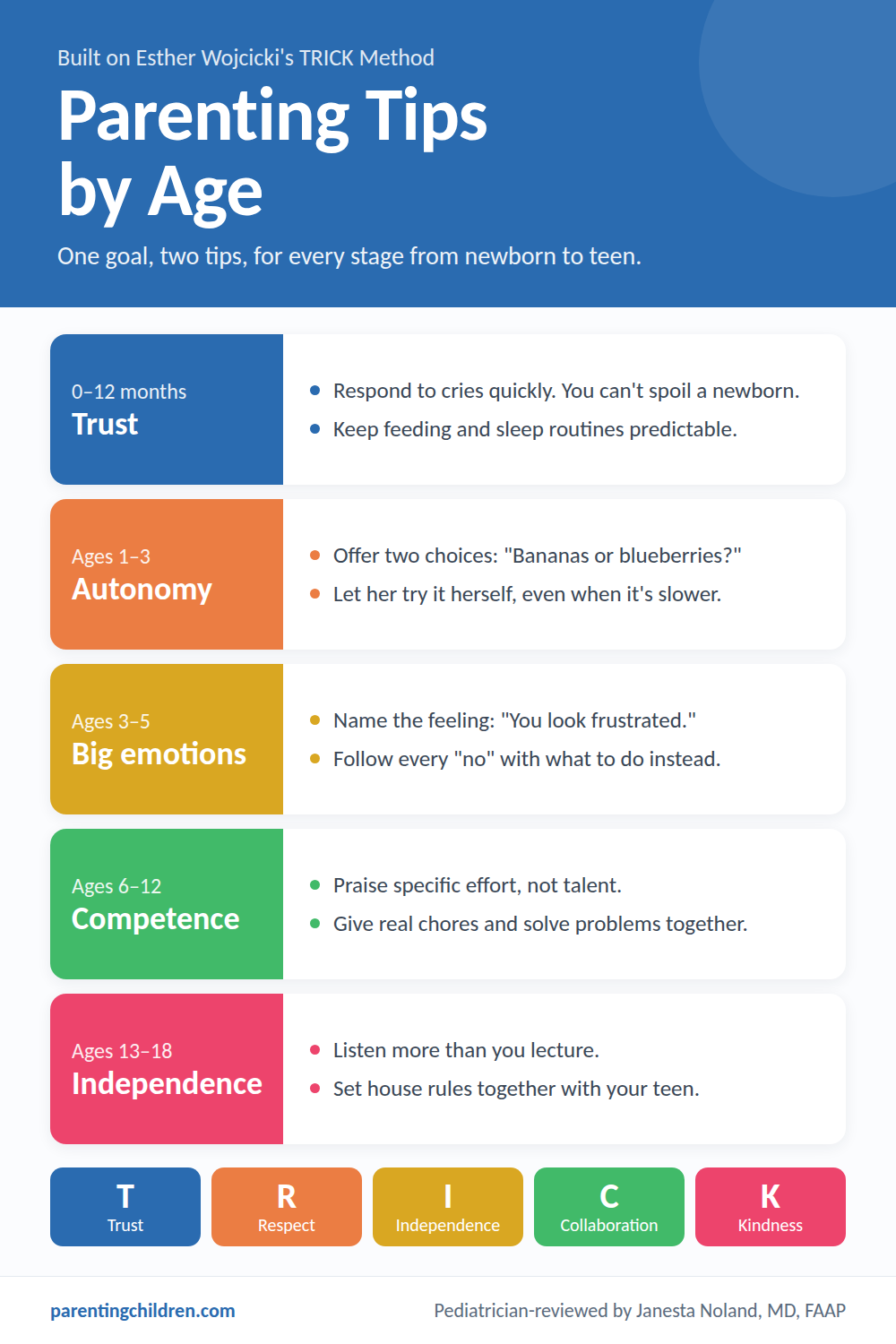
Printable Parenting Tips Cheat Sheet
Save this one-page guide to your phone, stick it on the fridge, or share it with your co-parent, grandparents, or babysitter so everyone is using the same approach.

Explore More Parenting Tips
Final Thoughts
Positive parenting isn’t about getting everything right. It’s about staying curious, staying connected, and adjusting your approach as your child grows. Use the TRICK Method as your anchor, tailor your strategies by age, and remember: the relationship always comes first.
Your child doesn’t need a perfect parent. She needs a present one.
Parenting Tips FAQs
What are the most important parenting tips?
Lead with five principles, summarized by the TRICK method: Trust, Respect, Independence, Collaboration, and Kindness. Pair them with age-appropriate expectations, consistent and calm discipline, and modeling the emotional regulation you want your child to learn.
What is positive parenting?
Positive parenting is an approach that guides children through warmth, encouragement, and clear, consistent limits rather than fear, shame, or harsh punishment. It focuses on teaching the behavior you want and building a strong parent-child relationship.
What are good parenting tips for toddlers?
Name her emotions out loud, offer two simple choices instead of open-ended questions, redirect instead of just saying no, and let her try things herself even when it’s slower. Predictable routines help toddlers feel secure.
How can I discipline my child without yelling?
Explain rules and consequences ahead of time, give one calm warning, and then follow through every time. The American Academy of Pediatrics recommends against spanking and harsh verbal discipline, and encourages positive strategies like praise for good behavior and logical consequences.
How much screen time is okay for kids?
The American Academy of Pediatrics advises no screen media other than video chatting for children younger than 18 months. For older children, create a family media plan that sets limits and keeps meals and bedrooms screen-free.
What are the developmental stages of early childhood?
Psychologist Erik Erikson described the first year of life as the stage of building trust, and roughly 18 months to age 3 as the stage of developing autonomy. Responsive caregiving supports trust in year one, while naming emotions and offering limited choices support autonomy in the toddler years.
What are the 4 C’s of positive parenting?
One popular way to summarize positive parenting is the 4 C’s: Compassion, Consistency, Choices, and Consequences. Together they build connection, set clear limits, encourage independence, and teach responsibility.
How do I offer choices without losing control?
Give limited, age-appropriate options (for example, “red or blue shirt?”) to promote decision-making while keeping clear boundaries in place. Limited choices work well from around age 1, as toddlers begin developing autonomy.
Sources and Trusted Resources
- CDC, Positive Parenting Tips by Age
- CDC, Essentials for Parenting Teens
- American Academy of Pediatrics, Effective Discipline to Raise Healthy Children (2018)
- HealthyChildren.org, from the American Academy of Pediatrics
- Mueller & Dweck (1998), Praise for Intelligence Can Undermine Children’s Motivation and Performance
- NIH / PubMed Central, Authoritative Parenting and Child Self-Regulation
- Esther Wojcicki, How to Raise Successful People (the TRICK Method)
This overview is super helpful! The TRICK framework gives parents practical tools while respecting the complexities of child development. I love the age-by-age breakdown, especially the take on teenagers; it’s all about biology, not just rebellion! Plus, emphasizing emotional regulation is spot on. Just a small suggestion: adding a note about cultural differences in discipline could be great since authoritative styles vary. Overall, it’s a well-organized and research-backed piece!
As someone who’s been in the parenting trenches for a while, this kind of content is exactly what I wish I’d found earlier. What I appreciate most is that it doesn’t make you feel like you’re failing, it just gives you practical things to actually try. The age breakdowns are spot on, and the point about offering kids limited choices instead of open-ended ones is such a small shift that makes a huge difference in real life. The TRICK acronym is also easy enough to actually remember when you’re in the middle of a meltdown moment. Would love to see more on sibling dynamics or blended families, but as a general foundation this is really well done
Hi Benny,
Thank you so much for this, it absolutely made our day!
You nailed exactly what we were going for: practical, no shame, just things you can try in the moment. And yes, that limited-choices trick is pure magic once you start using it. You’re so right that the real test of any framework is whether it survives a full-blown meltdown, so we’re thrilled TRICK passed for you!
Great news on the sibling dynamics and blended families fronts too, because both are on our content roadmap.
Stay tuned, and thank you again for being here and sharing your experience. It means the world!
Thank you,
Caroline Brin